Uncategorized
Peptide Synthesis and Quality Control: Understanding How Research Peptides Are Evaluated
Aug
Peptides have become an important subject in modern scientific research. From molecular biology and biochemistry to pharmaceutical research and cellular signaling studies, scientists continue to investigate how peptide structure influences molecular behavior. As interest in peptide science grows, so does the importance of producing and evaluating research peptides with reliable quality standards.
Peptide synthesis and quality control are closely connected. Producing a peptide with the expected sequence is only one part of the process. Researchers also need appropriate analytical methods to confirm identity, evaluate purity, investigate impurities, and document the characteristics of each batch.
For this reason, modern peptide research increasingly emphasizes characterization and traceability alongside synthesis. A well-documented research peptide gives scientists more information to consider when designing experiments and interpreting results.
This article explores the fundamentals of peptide synthesis and explains the major quality-control considerations researchers should understand when evaluating research peptides.
What Is Peptide Synthesis?
Peptide synthesis is the process of creating a peptide by joining amino acids into a specific sequence.
A peptide’s amino acid sequence is important because even small changes can influence its molecular properties. Therefore, researchers need reliable methods for producing the intended sequence while minimizing unwanted materials.
One of the best-known approaches is solid-phase peptide synthesis, commonly abbreviated as SPPS. This general strategy allows amino acids to be assembled sequentially while the growing peptide remains associated with a solid support.
Modern peptide chemistry has continued to develop beyond traditional approaches. Researchers and manufacturers now use different strategies depending on the peptide’s sequence, size, chemical characteristics, and intended research application.
The objective, however, remains consistent: produce the intended molecular structure as accurately and consistently as possible.
Why Peptide Synthesis Requires Quality Control
Peptide synthesis is not simply a matter of assembling amino acids. Chemical processes can produce related compounds or incomplete sequences, particularly as the complexity of a peptide increases.
Potential materials associated with a synthesized peptide can include:
- The intended peptide
- Incomplete peptide sequences
- Modified peptide species
- Residual synthesis-related materials
- Degradation products
- Other process-related impurities
The exact profile depends on the compound and manufacturing process.
Consequently, quality control helps researchers determine whether a peptide sample matches the characteristics expected from the intended research material.
The Relationship Between Synthesis and Purification
Synthesis and purification are separate but complementary parts of peptide production.
Synthesis creates the peptide sequence, while purification helps separate the desired material from unwanted components.
The purification strategy depends on the characteristics of the peptide and the impurities present in the sample. Chromatographic techniques are commonly important in this stage because they can separate molecular components according to their chemical properties.
However, purification does not eliminate the need for analytical testing. A purified sample still needs to be characterized to determine whether the expected compound is present and whether the resulting material meets the relevant research requirements.
This is why modern peptide quality control generally involves several analytical steps rather than relying on purification alone.
What Does Peptide Quality Control Mean?
Peptide quality control refers to the collection of procedures and analytical evaluations used to assess a peptide’s identity, purity, consistency, and other relevant characteristics.
A quality-control program may examine several factors, including:
Identity
Does the material correspond to the intended peptide?
Purity
How much of the analyzed sample corresponds to the desired peptide relative to detected impurities?
Molecular Characteristics
Does the measured molecular information correspond with the expected compound?
Appearance
Does the physical appearance of the material correspond with the documented specifications?
Stability
How does the material behave under the recommended storage and handling conditions?
Documentation
Can the material be traced to a specific production batch and analytical record?
Together, these factors provide a more complete understanding of a research peptide.
Why Peptide Identity Matters
Identity is one of the most fundamental aspects of peptide characterization.
A sample can appear visually normal while still requiring analytical confirmation. Therefore, researchers should not rely on appearance alone when determining whether a material corresponds to the intended compound.
Analytical techniques can provide evidence supporting molecular identity. Mass spectrometry, for example, can provide molecular mass information that researchers can compare with the expected characteristics of the peptide.
Identity testing becomes especially important when peptides have similar sequences, molecular masses, or related structures.
Understanding Peptide Purity
Purity is another major consideration in peptide quality control.
A peptide described as highly pure should ideally have analytical information supporting the reported purity value. Researchers should therefore look for documentation that explains how the measurement was obtained.
High-performance liquid chromatography, or HPLC, is widely used in peptide analysis. It can separate components in a sample and provide a chromatographic profile that helps researchers evaluate the relative presence of different components.
However, an HPLC purity percentage should not be treated as the only measure of quality.
A complete evaluation can also consider identity, molecular mass, analytical methodology, batch information, storage conditions, and other relevant characteristics.
The Role of HPLC in Peptide Analysis
HPLC is an important analytical tool in modern peptide research.
During analysis, the technique separates molecular components based on their interactions with the chromatographic system. The resulting chromatogram can provide information about the main peptide component and additional detected peaks.
Researchers can use this information to investigate whether a sample contains components other than the intended peptide.
The exact analytical conditions depend on the compound and laboratory methodology. Therefore, researchers should pay attention to the testing method and documentation rather than focusing only on a single reported percentage.
HPLC is most useful when interpreted as part of a broader analytical strategy.
Mass Spectrometry and Molecular Confirmation
Mass spectrometry provides another important layer of peptide characterization.
The technique measures molecular ions according to their mass-to-charge characteristics. Researchers can then compare the resulting information with the expected molecular properties of the peptide.
This can provide useful evidence regarding molecular identity and help distinguish the intended compound from certain related materials.
Mass spectrometry can also complement chromatographic analysis. While chromatography provides information about separation and detected components, mass spectrometry can provide molecular mass information.
Using multiple analytical techniques can therefore provide a stronger characterization profile than relying on a single test.
Why Multiple Quality-Control Tests Matter
No single analytical method provides every piece of information about a peptide.
For example, a chromatographic method may provide useful information about purity, while mass spectrometry can provide information related to molecular mass.
Other analytical approaches may be relevant depending on the research material and laboratory requirements.
This concept is sometimes described as orthogonal testing, where different analytical techniques provide complementary information.
The advantage is straightforward: independent measurements can help researchers build a more complete picture of a sample.
Peptide Stability and Quality
Quality control does not end when a peptide is synthesized and tested.
Peptides can be affected by environmental conditions such as temperature, moisture, pH, oxidation, and repeated handling. The sensitivity of each peptide depends on its individual molecular characteristics.
For this reason, stability is an important part of responsible peptide research.
Researchers should consider the documented storage conditions for a specific material and maintain appropriate laboratory records. Changes in appearance or analytical characteristics may also warrant further investigation.
A peptide that was appropriately characterized when produced may not necessarily maintain identical characteristics if it is stored or handled improperly.
The Importance of Batch Testing
Batch-specific information is valuable because manufacturing processes can produce differences between individual production lots.
A certificate or analytical report connected to a specific batch provides more useful information than a generic statement about an entire product catalog.
Researchers evaluating a research peptide may therefore want to review:
- Batch or lot number
- Testing date
- Reported purity
- Identity information
- Molecular mass data
- Analytical method
- Laboratory information
- Storage recommendations
This information improves traceability and can help researchers maintain better experimental records.
What Is a Certificate of Analysis?
A Certificate of Analysis, commonly called a CoA, is a document that summarizes analytical information associated with a particular material or batch.
The contents can vary between suppliers and laboratories. However, a useful CoA may identify the compound, batch number, testing information, analytical results, and relevant specifications.
Researchers should examine CoAs carefully rather than assuming that every document provides the same level of information.
A strong documentation system makes it easier to connect a research material with its analytical history.
Third-Party Laboratory Testing
Independent laboratory testing can provide additional confidence in analytical results.
A third-party laboratory operates separately from the organization producing or supplying the material. Depending on the testing program, independent laboratories may perform analytical assessments such as chromatography, mass spectrometry, or other relevant tests.
Third-party testing does not automatically guarantee that a material is appropriate for every experiment. Nevertheless, independent analytical information can improve transparency and provide researchers with additional evidence to evaluate.
Researchers should also consider the laboratory’s qualifications, the analytical methods used, and whether the documentation corresponds to the specific batch.
Common Quality-Control Mistakes to Avoid
Researchers can sometimes place too much emphasis on one quality indicator.
For example, a high reported purity percentage does not necessarily provide complete information about identity, stability, or every possible impurity.
Other common mistakes include:
Relying Only on Product Claims
Marketing statements should not replace analytical documentation.
Ignoring Batch Information
Batch-specific records provide greater traceability than general product descriptions.
Treating Appearance as Proof of Quality
Visual inspection can be useful, but it cannot independently confirm molecular identity or purity.
Overlooking Storage Requirements
Incorrect storage may affect the characteristics of a peptide after testing.
Using One Test as the Complete Quality Standard
Different analytical methods provide different types of information.
A stronger approach considers the available evidence as a whole.
How Researchers Can Evaluate a Research Peptide
Before incorporating a peptide into an experiment, researchers can review several basic questions.
Is the compound clearly identified?
The product documentation should make the research material unambiguous.
Is there analytical evidence?
Look for appropriate analytical data rather than unsupported purity claims.
Is the batch traceable?
A lot or batch number can help connect the material with its analytical documentation.
Are storage conditions documented?
Researchers should understand how the material is expected to be stored and handled.
Are analytical methods described?
Testing information becomes more meaningful when researchers understand which analytical techniques were used.
Is the documentation consistent?
The product label, batch information, analytical report, and other records should correspond with one another.
These checks can help laboratories make more informed decisions when sourcing research materials.
Improving Reproducibility in Peptide Research
Reproducibility is a central principle of scientific research.
When researchers use well-characterized materials and maintain accurate records, it becomes easier to understand differences between experiments.
Detailed documentation can include the peptide identity, batch number, analytical information, storage conditions, preparation records, and experimental conditions relevant to the study.
In addition, researchers should distinguish between observations supported by analytical data and assumptions based on product descriptions.
This careful approach strengthens experimental reporting and makes research findings easier to evaluate.
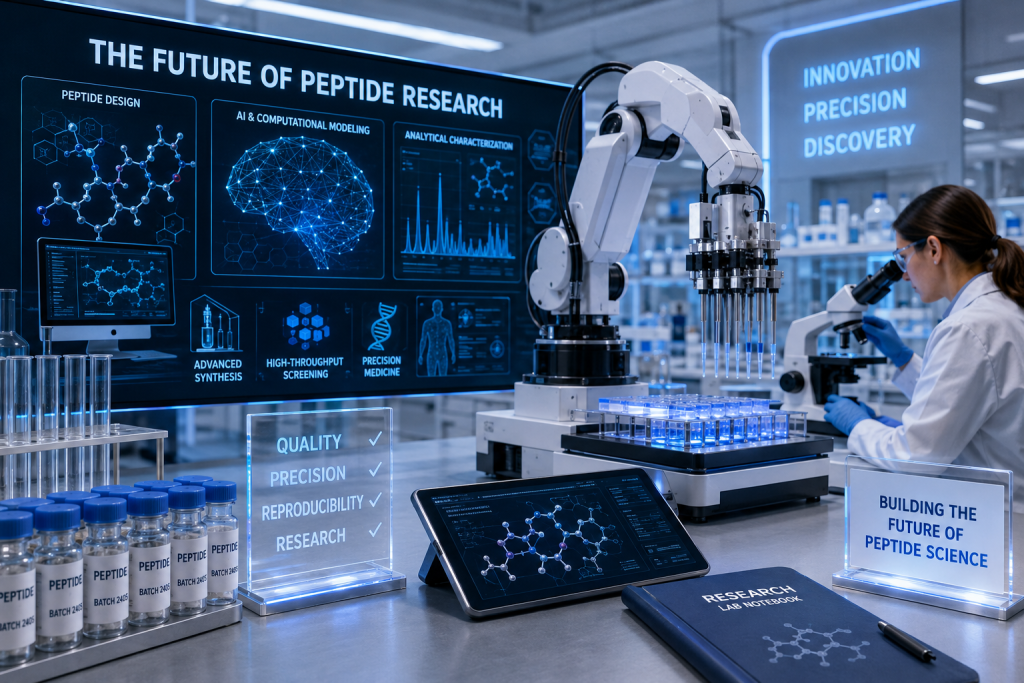
The Future of Peptide Quality Control
Peptide quality control is likely to become increasingly sophisticated as analytical technologies improve.
Automation, advanced chromatography, high-resolution mass spectrometry, computational analysis, and improved data management can all contribute to more detailed characterization.
At the same time, researchers are increasingly interested in reproducibility and transparent documentation.
Future peptide quality systems may therefore place greater emphasis on integrated analytical profiles rather than isolated purity measurements.
The combination of chemical synthesis, analytical science, digital records, and computational tools could provide researchers with increasingly detailed information about peptide materials.
Why Quality Control Matters to Modern Peptide Research
The growing interest in peptides creates both opportunities and responsibilities.
As scientists investigate new compounds and biological pathways, they need research materials that can be characterized and documented appropriately.
Quality control helps bridge the gap between synthesis and scientific application. It gives researchers information they can use when assessing whether a material is suitable for a particular experimental purpose.
Ultimately, reliable peptide research depends on more than obtaining a compound with the correct name. It requires attention to identity, purity, analytical testing, storage, traceability, and experimental design.
Conclusion
Peptide synthesis has become an important part of modern molecular research, but synthesis alone does not define the quality of a research peptide. Proper purification, characterization, analytical testing, documentation, and storage are equally important considerations.
HPLC can provide valuable information about chromatographic purity, while mass spectrometry can contribute molecular identity information. When complementary analytical approaches are combined with batch-specific documentation, researchers can develop a more complete understanding of their research materials.
As peptide science continues to advance, quality control will remain central to reliable experimentation. Researchers who prioritize transparent documentation and appropriate characterization are better positioned to maintain reproducible and scientifically meaningful laboratory work.
For HK Peptide Store and the wider research community, understanding these principles is an important step toward more informed peptide research. As analytical technologies continue to develop, the ability to evaluate peptide materials accurately will become even more important.
Frequently Asked Questions
What is peptide synthesis?
Peptide synthesis is the process of producing a peptide by assembling amino acids into a specific sequence. Several synthesis strategies exist, with solid-phase peptide synthesis being one widely used approach.
Why is quality control important for peptides?
Quality control helps researchers evaluate characteristics such as identity, purity, molecular properties, stability, and batch consistency. It supports better documentation and more reliable research practices.
What is HPLC used for in peptide research?
HPLC can separate components within a sample and provide a chromatographic profile. Researchers commonly use it to evaluate peptide purity and investigate detected components.
What does mass spectrometry do for peptides?
Mass spectrometry provides molecular mass information and can support the characterization and identification of peptide materials.
Is a high purity percentage enough to prove peptide quality?
No. Purity is important, but it is only one part of peptide characterization. Researchers should also consider identity, analytical methods, batch information, stability, and documentation.
What is a peptide Certificate of Analysis?
A Certificate of Analysis is a document containing analytical information about a particular material or batch. Depending on the supplier and laboratory, it may include identity, purity, testing information, and other specifications.
Why is batch-specific testing useful?
Batch-specific testing connects analytical results to a particular production lot. This improves traceability and gives researchers more relevant information about the material being evaluated.
How should research peptides be stored?
Storage requirements vary by peptide. Researchers should follow the documented storage recommendations for the specific material and consider factors such as temperature, moisture, light, and stability.
Can visual inspection confirm peptide purity?
No. Appearance can provide useful basic information, but molecular identity and purity require appropriate analytical testing.
Why are multiple analytical methods useful?
Different analytical techniques provide different types of information. Combining complementary methods can give researchers a more complete characterization profile than relying on a single test.
