Uncategorized
GHK-Cu Peptides: Exploring Copper Peptide Research, Structure, and Scientific Potential
Aug
GHK-Cu peptides have attracted growing attention in modern scientific research because of their interesting molecular structure and relationship with copper. Also known as copper tripeptide-1, GHK-Cu is a naturally occurring copper-binding peptide that researchers have studied for decades.
Interest in GHK-Cu has expanded across several scientific fields, including molecular biology, biochemistry, skin biology, tissue research, and peptide chemistry. Researchers continue to investigate how this small peptide interacts with copper and how its molecular characteristics may contribute to biological processes.
As peptide science continues to develop, GHK-Cu provides an interesting example of how a relatively small molecule can become the subject of extensive scientific investigation.
However, understanding GHK-Cu requires more than looking at its popularity. Researchers need to consider its structure, copper-binding characteristics, analytical testing, stability, and the difference between laboratory findings and established clinical applications.
This article explores the science behind GHK-Cu peptides, current areas of research, quality-control considerations, and why copper peptides remain an important subject in peptide research.
What Is GHK-Cu?
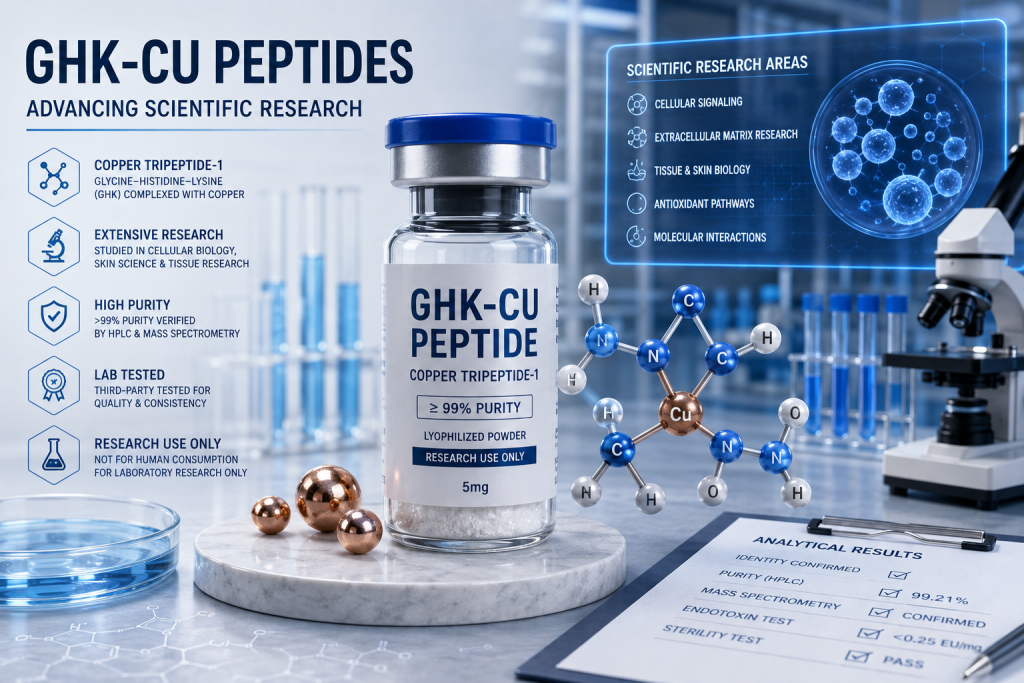
GHK-Cu is a copper-binding peptide composed of three amino acids: glycine, histidine, and lysine.
The abbreviation GHK comes from the first letters of these amino acids:
- G – Glycine
- H – Histidine
- K – Lysine
GHK can form a complex with copper ions, resulting in what is commonly referred to as GHK-Cu.
This copper-binding characteristic is one of the main reasons researchers are interested in the compound. Copper is an essential trace element involved in numerous biological processes, including enzymatic activity and cellular metabolism.
Therefore, studying the interaction between a peptide and a metal ion can provide valuable insights into molecular biology and biochemistry.
The Molecular Structure of GHK-Cu
The small size of GHK-Cu makes it particularly interesting from a peptide research perspective.
Unlike large proteins containing hundreds or thousands of amino acids, GHK is a short tripeptide. Nevertheless, its ability to interact with copper gives it properties that researchers can investigate using biochemical and analytical techniques.
The relationship between the peptide and copper is important because the metal ion can influence the molecular characteristics of the complex.
Researchers studying GHK-Cu may therefore investigate areas such as:
- Molecular structure
- Copper binding
- Peptide stability
- Chemical behavior
- Cellular interactions
- Analytical characterization
- Biological signaling
Understanding these characteristics helps scientists develop a more complete picture of copper peptide chemistry.
Why Copper Matters in Peptide Research
Copper is not simply an additional component of GHK-Cu.
Copper is a biologically important element that participates in various enzymatic and cellular processes. Because copper can interact with proteins, peptides, and other molecules, researchers have long investigated its role in biological chemistry.
A copper-binding peptide provides a useful model for studying these interactions.
Researchers can investigate how copper association affects molecular properties and how changes in the surrounding environment may influence the peptide-metal complex.
This makes GHK-Cu relevant not only to peptide science but also to broader areas of coordination chemistry and biological research.
GHK-Cu and Skin Biology Research
One of the most widely discussed areas of GHK-Cu research involves skin biology.
Researchers have investigated copper peptides in connection with processes involving extracellular matrix components, cellular signaling, and skin-related biology.
Some studies have explored how GHK-Cu interacts with biological systems associated with tissue structure and cellular activity. However, laboratory research should be interpreted carefully.
A finding observed in a cell model, biochemical experiment, or other research system does not automatically establish the same outcome in humans.
This distinction is particularly important because GHK-Cu is sometimes discussed online using broad cosmetic or wellness claims that go beyond what individual studies can demonstrate.
Scientific research requires evaluating the evidence according to the experimental model, methodology, and study design.
GHK-Cu and Extracellular Matrix Research
The extracellular matrix is a network of molecules surrounding cells. It provides structural support and participates in communication between cells and their surrounding environment.
Researchers have studied GHK-related compounds in connection with extracellular matrix biology.
This research is interesting because molecules associated with the extracellular matrix can influence how tissues maintain their structure and respond to changes in their environment.
GHK-Cu research therefore provides an opportunity to investigate interactions between peptide chemistry and tissue-related biological processes.
However, researchers continue to examine the mechanisms involved, and individual experimental findings should not be interpreted as proof of a specific therapeutic outcome.
GHK-Cu and Cellular Research
Another area of interest involves cellular biology.
Scientists can use laboratory models to examine how GHK-Cu interacts with cells under controlled experimental conditions. Depending on the research objective, investigators may examine molecular signaling, gene expression, cellular responses, or other measurable endpoints.
These studies can help researchers develop hypotheses about the potential biological roles of copper peptides.
Nevertheless, laboratory models have limitations. Results from isolated cells may not accurately represent the complexity of a complete biological system.
Consequently, researchers need to distinguish between mechanistic research and established clinical evidence.
GHK-Cu and Peptide Chemistry
From a chemistry perspective, GHK-Cu provides an interesting example of peptide-metal interactions.
The peptide contains functional groups capable of interacting with copper. This interaction can be investigated using analytical and spectroscopic techniques.
Researchers may study how environmental conditions influence the complex, including factors such as pH, temperature, concentration, and the presence of other chemical species.
This type of research can contribute to a broader understanding of how small peptides interact with metal ions.
As peptide chemistry becomes increasingly sophisticated, these studies may also help researchers design and characterize other peptide-based systems.
How GHK-Cu Is Studied in the Laboratory
Researchers can use multiple analytical methods to characterize GHK-Cu.
The appropriate method depends on the research objective and the type of information required.
High-Performance Liquid Chromatography
HPLC can help researchers evaluate the chromatographic profile of a peptide sample.
It may be used to assess relative purity and identify additional detected components.
Mass Spectrometry
Mass spectrometry can provide molecular mass information and help researchers investigate the identity of the peptide or peptide-related species.
Spectroscopic Techniques
Various spectroscopic methods may provide information about molecular interactions and the relationship between peptides and metal ions.
Stability Testing
Researchers may also investigate how GHK-Cu behaves under different storage and environmental conditions.
Using complementary analytical techniques can provide a more detailed characterization profile than relying on a single test.
Why GHK-Cu Purity Matters
Purity is an important consideration when working with any research peptide.
A GHK-Cu sample may contain the intended compound alongside related materials, synthesis byproducts, residual substances, or degradation products.
Therefore, researchers should consider analytical documentation when evaluating a research material.
A reported purity percentage can be useful, but it should not be viewed in isolation.
Researchers should also consider:
- Peptide identity
- Copper association
- Analytical methodology
- Batch information
- Molecular mass data
- Storage conditions
- Stability information
- Laboratory documentation
Together, these factors provide a more meaningful assessment of research material quality.
GHK-Cu Stability and Storage Research
Peptide stability is another important consideration.
Environmental conditions can influence peptide materials, and copper-containing complexes may require particular attention because metal interactions can affect molecular behavior.
Researchers should follow the documented storage conditions for the specific material they are studying.
Factors that may be relevant include:
- Temperature
- Moisture
- Light exposure
- pH
- Oxygen exposure
- Repeated handling
- Storage duration
The precise stability characteristics depend on the material and formulation.
Consequently, researchers should avoid assuming that the same storage conditions apply to every peptide.
Understanding GHK-Cu Research Quality
The popularity of GHK-Cu means researchers may encounter different levels of product documentation.
A responsible research approach focuses on evidence rather than marketing language.
When evaluating GHK-Cu research material, laboratories may consider whether documentation clearly identifies the compound and provides appropriate analytical information.
Useful documentation may include:
- Product identification
- Batch or lot number
- Purity information
- Analytical test results
- Molecular mass information
- Testing date
- Storage recommendations
- Laboratory information
Batch-specific documentation is particularly useful because it connects analytical results to a specific production lot.
GHK-Cu and Third-Party Testing
Independent laboratory testing can provide additional analytical information about research materials.
Third-party laboratories can perform analytical assessments using methods such as chromatography and mass spectrometry, depending on the testing requirements.
Researchers should examine the actual documentation rather than relying solely on a statement that a product has been “third-party tested.”
Important details include the identity of the testing laboratory, the testing date, the batch number, the analytical method, and the reported findings.
This approach supports greater transparency and makes research materials easier to evaluate.
GHK-Cu in Modern Peptide Research
GHK-Cu represents an interesting intersection between peptide chemistry, metal-ion biology, and cellular research.
Because the molecule combines a short peptide with copper-binding behavior, researchers can investigate questions that involve both peptide structure and metal coordination.
This makes GHK-Cu useful as a research subject in studies involving molecular interactions, biochemical mechanisms, and biological systems.
At the same time, researchers should remain careful when interpreting claims surrounding the compound.
The scientific value of GHK-Cu comes from measurable molecular and biological characteristics, not from unsupported claims.
GHK-Cu Research Versus Clinical Claims
It is important to distinguish scientific investigation from medical or therapeutic claims.
Researchers may investigate a compound in laboratory systems without demonstrating that the same effects occur in humans.
For example, a study involving cells may identify a particular biological response. That result can provide a foundation for further research, but it does not automatically establish a clinical benefit.
Similarly, observations from experimental models require additional evidence before broad conclusions can be made.
This distinction helps maintain scientific accuracy and prevents research findings from being overstated.
The Future of GHK-Cu Research
Research involving GHK-Cu continues to evolve as analytical technologies improve.
Advanced chromatography, high-resolution mass spectrometry, molecular modeling, imaging techniques, and computational biology may provide researchers with increasingly detailed information about peptide-metal interactions.
Future research may also examine how molecular structure influences copper binding, stability, cellular interactions, and other measurable characteristics.
Furthermore, improvements in peptide synthesis and purification can make it easier for researchers to investigate carefully characterized compounds.
The broader trend toward transparent analytical documentation is likely to remain important as peptide science develops.
What Researchers Should Consider When Evaluating GHK-Cu
Researchers considering GHK-Cu for laboratory work can begin with several basic questions.
Is the compound clearly identified?
The material should have clear identification and appropriate documentation.
Is there batch-specific information?
A batch or lot number can help connect the material with analytical records.
Is purity supported by testing?
A reported purity value is more meaningful when supported by an appropriate analytical method.
Is molecular identity documented?
Analytical information such as mass spectrometry can provide useful evidence supporting molecular characterization.
Are storage conditions available?
Researchers should have access to appropriate handling and storage information.
Is the documentation transparent?
Clear documentation helps laboratories maintain reliable research records and assess materials more effectively.
Why GHK-Cu Remains an Interesting Research Peptide
GHK-Cu continues to attract scientific attention because it combines several interesting characteristics.
It is a small peptide. It interacts with copper. It can be studied using multiple analytical approaches. Furthermore, researchers have investigated its relationship with biological systems for many years.
These characteristics make GHK-Cu a useful subject for studying peptide-metal interactions and related biological mechanisms.
As peptide research continues to expand, compounds such as GHK-Cu demonstrate why careful molecular characterization remains essential.
Conclusion
GHK-Cu is a copper-binding tripeptide that has become an established subject of peptide and biochemical research. Its molecular structure, copper association, stability, and interactions with biological systems provide researchers with multiple areas to investigate.
Modern analytical methods such as HPLC and mass spectrometry can help researchers characterize GHK-Cu and evaluate the quality of research materials. At the same time, batch-specific documentation, stability information, and appropriate laboratory controls contribute to more reproducible research.
Although GHK-Cu is frequently discussed in cosmetic, wellness, and therapeutic contexts, scientific interpretation should remain grounded in the evidence available for each specific research question.
As peptide science advances, continued research into GHK-Cu may provide further insight into peptide-metal chemistry, molecular signaling, cellular biology, and related fields.
For researchers, the most important principles remain consistent: use appropriately characterized materials, review analytical documentation, maintain careful laboratory records, and distinguish experimental findings from established clinical conclusions.
Frequently Asked Questions About GHK-Cu Peptides
What is GHK-Cu?
GHK-Cu is a copper-binding peptide consisting of the amino acids glycine, histidine, and lysine. It is also commonly referred to as copper tripeptide-1.
What does GHK stand for?
GHK refers to the three amino acids that make up the peptide: glycine, histidine, and lysine.
Why is GHK-Cu studied?
Researchers study GHK-Cu because of its copper-binding properties and its relationship with areas such as peptide chemistry, cellular biology, skin biology, and molecular signaling.
How is GHK-Cu analyzed?
Researchers may use analytical techniques such as HPLC, mass spectrometry, and other appropriate laboratory methods to investigate identity, purity, molecular characteristics, and stability.
Why is copper important in GHK-Cu research?
Copper is a biologically important metal ion involved in numerous biochemical processes. Its interaction with GHK makes the compound interesting for peptide-metal research.
Is GHK-Cu the same as GHK?
No. GHK refers to the tripeptide itself, while GHK-Cu refers to the copper-associated form of the peptide.
Why is purity important for GHK-Cu research?
Purity is important because unwanted materials may influence experimental results. Researchers therefore evaluate purity alongside identity, analytical data, batch information, and stability.
Does GHK-Cu research prove medical benefits?
Not necessarily. Laboratory findings provide scientific information, but results from biochemical, cellular, or other experimental models do not automatically establish clinical benefits in humans.
What should researchers look for in GHK-Cu documentation?
Researchers can look for clear compound identification, batch information, analytical testing, purity data, molecular characterization, storage information, and appropriate laboratory documentation.
Why is batch-specific testing useful?
Batch-specific testing connects analytical results to a particular production lot. This improves traceability and gives researchers more relevant information when evaluating a research material.
