Uncategorized
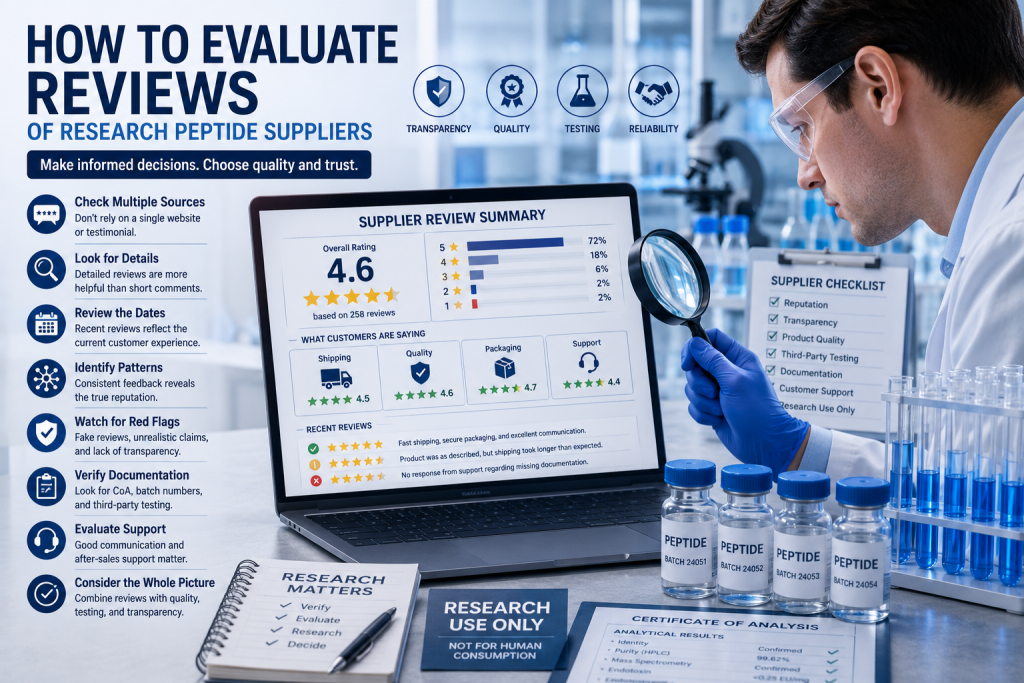
How to Evaluate Reviews of Research Peptide Suppliers
Aug
Choosing a research peptide supplier requires more than comparing product names and prices. Reviews can provide useful information about a supplier’s reputation, customer service, packaging, shipping, documentation, and overall reliability. However, not every review should be trusted at face value.
As interest in research peptides continues to grow, more suppliers are appearing online. This gives researchers more options, but it also makes it harder to identify reliable information. Some reviews may be genuine and detailed, while others may be copied, manipulated, overly promotional, outdated, or based on experiences that have little relevance to research quality.
For this reason, researchers should learn how to evaluate reviews carefully.
A five-star rating alone does not prove that a supplier provides high-quality research materials. Likewise, a small number of negative reviews does not automatically mean that a supplier is unreliable. The most useful approach is to examine the complete pattern of available information.
This guide explains how to evaluate reviews of 87 identify warning signs, compare different sources of feedback, and make better-informed decisions when selecting research materials.
Why Supplier Reviews Matter in Peptide Research
Reviews can offer information that may not appear on a supplier’s product page.
For example, previous customers may discuss their experiences with:
- Order processing
- Customer support
- Shipping times
- Packaging quality
- Product labeling
- Batch documentation
- Certificates of Analysis
- Website communication
- Order accuracy
- Problem resolution
This information can help researchers understand how a supplier operates in practice.
However, reviews should only be one part of the evaluation process. They should not replace analytical documentation, scientific information, batch records, or independent testing.
A reliable research process requires examining both the supplier’s reputation and the available evidence concerning the research materials.
Do Not Judge a Supplier by Star Ratings Alone
One of the most common mistakes is focusing only on the average star rating.
A supplier with a 5.0 rating may look impressive. Nevertheless, researchers should ask important questions about that rating.
How many reviews contributed to the score?
Were the reviews published over several years or within a short period?
Do the reviews contain useful details?
Are the reviewers describing genuine experiences?
A perfect rating based on only a few short reviews may provide less useful information than a 4.6 rating supported by hundreds of detailed reviews collected over time.
Similarly, a company with some negative reviews may still have a strong overall reputation if the complaints are isolated and the business responds professionally.
Instead of looking only at the final number, examine the pattern behind it.
Look for Detailed and Specific Reviews
Detailed reviews are often more useful than simple comments such as:
“Great company.”
“Excellent product.”
“Five stars.”
These comments may be genuine, but they provide very little information.
A more useful review may explain what happened during the customer’s experience. For example, it might discuss whether the order arrived as expected, whether the packaging was secure, whether customer service responded to a problem, or whether batch-specific documentation was available.
Specific details can help researchers understand why the reviewer formed their opinion.
However, detail alone does not prove that a review is genuine. It is still important to compare multiple reviews and look for consistent patterns.
Check Where the Reviews Are Published
The source of a review matters.
Reviews published directly on a supplier’s website can provide useful feedback, but they should not be the only source examined. A business generally has more control over the content displayed on its own website.
Therefore, researchers may want to compare information from multiple independent sources.
Possible sources can include:
- Independent review platforms
- Search engine business profiles
- Industry discussions
- Scientific or research communities
- Professional forums where appropriate
- Social media discussions
- Supplier testimonials
- Customer feedback on third-party platforms
The goal is not to believe every comment found online. Instead, compare the information available from different places.
If the same strengths and weaknesses appear repeatedly across independent sources, the pattern may provide more useful insight than isolated reviews.
Pay Attention to Review Patterns
Individual reviews can sometimes be misleading. Patterns are usually more valuable.
For example, one customer may report a delayed delivery because of a temporary shipping issue. That does not necessarily indicate a long-term problem.
However, if many unrelated reviews repeatedly mention the same issue, researchers should take notice.
Look for recurring comments about:
Shipping and Order Processing
Are customers consistently reporting delayed orders or missing packages?
Customer Support
Does the supplier respond when customers have questions or problems?
Documentation
Do reviewers mention receiving appropriate product or batch information?
Packaging
Are products consistently described as securely packaged and properly labeled?
Order Accuracy
Do customers report receiving the materials they ordered?
Transparency
Does the company provide clear information, or do customers repeatedly report confusion about products and documentation?
A repeated pattern deserves more attention than one isolated complaint.
Watch for Reviews That Look Artificial
Unfortunately, not all online reviews are genuine.
Some warning signs may include a large number of reviews using nearly identical language, unusually generic praise, repeated phrases, or several reviews appearing within a very short period.
Examples of possible warning signs include:
- Reviews that sound almost identical
- Repeated use of the same unusual phrases
- Extremely promotional language without details
- Many reviews posted on the same date
- Accounts with little or no review history
- Reviews discussing products in vague terms
- Comments that appear copied from marketing materials
These signs do not automatically prove manipulation. However, they should encourage researchers to look more carefully at the available information.
Authentic customer feedback often varies in writing style, detail, and experience.
Read Both Positive and Negative Reviews
Do not only read five-star reviews.
Negative and middle-rated reviews can sometimes provide the most useful information because they reveal how a supplier handles problems.
A company cannot always prevent every shipping delay, website error, or customer-service issue. What matters is how the problem is handled.
When reading negative reviews, consider:
- Was the complaint specific?
- Does the reviewer explain what happened?
- Did the supplier respond?
- Was the issue resolved?
- Do other reviews report the same problem?
- Does the complaint appear recent?
- Was the issue related to the supplier or an external service?
This approach helps researchers distinguish between occasional problems and consistent operational weaknesses.
A reliable supplier may receive negative feedback occasionally. However, repeated unresolved complaints about the same issue can be a more serious warning sign.
Consider How the Supplier Responds to Reviews
Supplier responses can reveal important information about professionalism.
When a business receives criticism, a constructive response may acknowledge the concern, request additional information, or explain how the issue will be investigated.
Aggressive, dismissive, or overly defensive responses can be warning signs.
At the same time, researchers should avoid judging a company based on one response alone. Look for a broader pattern.
Questions to consider include:
- Does the supplier respond professionally?
- Do responses address the actual complaint?
- Does the company attempt to resolve problems?
- Are customers given clear information?
- Does the supplier communicate respectfully?
A professional response does not prove product quality. Nevertheless, consistent and transparent communication can provide useful information about how the company handles customer concerns.
Check the Date of Each Review
Older reviews may not accurately represent a supplier’s current operations.
A company can change its management, manufacturing processes, testing procedures, website, customer support, or shipping partners over time.
Therefore, pay attention to when reviews were published.
A strong review from several years ago may be less relevant than recent feedback describing the supplier’s current practices.
At the same time, do not focus exclusively on the newest reviews. A useful evaluation can examine both recent feedback and long-term reputation.
Ask yourself:
Has the company maintained a consistent reputation over time?
Are recent reviews improving or becoming more negative?
Did a sudden change occur in the pattern of feedback?
Review dates can provide important context.
Separate Product Claims From Customer-Service Reviews
A customer may leave a positive review because shipping was fast. Another customer may leave a positive review because the website was easy to use.
These experiences may be useful, but they do not independently confirm the identity or purity of a research peptide.
This distinction is essential.
Reviews can provide information about a supplier’s service. Analytical documentation provides information about the material itself.
Researchers should therefore separate claims into different categories.
Service Information
Customer reviews may help evaluate:
- Communication
- Shipping
- Packaging
- Website usability
- Order accuracy
- Problem resolution
Research Material Information
Analytical documentation may help evaluate:
- Identity
- Purity
- Molecular characteristics
- Batch information
- Testing methodology
- Storage information
Do not assume that excellent customer service proves research quality. Both areas should be evaluated separately.
Look Beyond Testimonials on the Supplier’s Website
Testimonials displayed on a website can help demonstrate customer satisfaction, but they should not be treated as the complete picture.
A professional supplier may publish genuine testimonials. Nevertheless, researchers should also seek independent information when possible.
Compare the company’s own testimonials with feedback from other sources.
If the same positive points appear repeatedly across multiple independent locations, that may strengthen the overall pattern.
Conversely, if a website displays only perfect reviews while independent sources show frequent unresolved complaints, researchers should investigate further.
The strongest evaluation comes from comparing evidence rather than relying on a single source.
Check Whether Reviews Discuss Transparency
Transparency is an important consideration when evaluating research peptide suppliers.
A supplier should provide clear information about the materials it offers and avoid making unsupported claims.
Reviews may reveal whether customers found the company transparent about:
- Product descriptions
- Research-use limitations
- Batch numbers
- Analytical reports
- Certificates of Analysis
- Shipping policies
- Return policies
- Customer support
- Storage guidance
A lack of clear information does not automatically prove that a supplier is unreliable. However, repeated customer complaints about missing documentation or unclear product information should be investigated.
Evaluate Certificates of Analysis Separately
Some reviews may state that a supplier provides Certificates of Analysis, often called CoAs.
This can be useful information, but researchers should not stop there.
The actual documentation should be examined where available.
Consider whether the report includes relevant information such as:
- Clear compound identification
- Batch or lot number
- Test date
- Analytical method
- Reported results
- Laboratory information
A generic statement saying “all products are tested” provides less information than documentation connected to a specific batch.
Likewise, a positive review mentioning a CoA does not independently confirm the accuracy of the report.
Researchers should review analytical information directly whenever possible.
Compare Reviews With Other Evidence
The best approach is to build a complete picture.
Reviews are one source of information. They should be compared with other factors.
A research peptide supplier can be evaluated using a combination of:
Website Transparency
Is the company clear about what it sells and how it operates?
Analytical Documentation
Does the supplier provide relevant batch-specific information?
Independent Testing
Is there evidence of appropriate third-party analysis where claimed?
Product Information
Are products clearly identified and accurately described?
Customer Feedback
What patterns appear across multiple review sources?
Communication
Does the company respond clearly and professionally?
Research Focus
Does the supplier clearly distinguish research materials from approved medicines or human-use products?
Looking at these factors together can provide a more balanced evaluation.
Be Careful With Social Media Reviews
Social media can provide useful real-time feedback, but it can also create confusion.
Posts may be influenced by sponsorships, personal relationships, promotional campaigns, or limited individual experiences.
A social media post showing a product package does not confirm identity, purity, or analytical quality.
Likewise, a highly enthusiastic influencer-style review should not replace independent documentation.
When evaluating social media feedback, ask:
Was the content sponsored?
Is the reviewer clearly identifying a personal experience?
Does the reviewer provide specific information?
Are there similar reports from independent users?
Is the post primarily promotional?
Social media can be part of the research process, but it should not become the only source of information.
Common Red Flags When Evaluating Reviews
Certain patterns should encourage additional caution.
Possible red flags include:
- Hundreds of nearly identical reviews
- No detailed independent feedback
- Repeated complaints about missing orders
- Consistent reports of unresponsive customer support
- Claims that cannot be supported by documentation
- Reviews making extreme medical promises
- Sudden large increases in perfect ratings
- Missing or unclear company information
- Complaints about mismatched batch documentation
- Pressure to make immediate purchases
No single factor automatically proves that a supplier is unreliable. However, several warning signs appearing together may justify a more careful evaluation.
Why Scientific Claims in Reviews Require Extra Caution
Research peptide reviews sometimes contain claims about dramatic biological or medical outcomes.
These claims should be approached carefully.
Personal experiences do not replace controlled scientific evidence. In addition, reviewers may not know the exact identity, purity, handling history, or storage conditions of the material they received.
Anecdotal reports can be affected by many variables.
For this reason, researchers should avoid treating customer testimonials as scientific proof.
When evaluating a supplier, focus on measurable and verifiable information such as documentation, analytical testing, batch traceability, and transparent business practices.
Create a Simple Supplier Review Checklist
Before choosing a supplier, researchers can use a structured evaluation process.
Ask the following questions:
Are there reviews from multiple sources?
Do not rely only on testimonials displayed by the supplier.
Are the reviews detailed and varied?
Look for genuine descriptions of different customer experiences.
Are the reviews recent?
Current information may better reflect the supplier’s present operations.
Is there a consistent pattern?
Repeated comments can reveal important strengths or weaknesses.
How does the supplier handle complaints?
Professional responses and problem resolution can provide useful insight.
Does the supplier provide analytical documentation?
Reviews should be supported by direct evidence where possible.
Are research materials clearly described?
Transparent information is generally more useful than vague marketing claims.
Does the supplier separate research information from medical claims?
Responsible communication matters.
This checklist can help researchers avoid making decisions based on one rating or one highly persuasive review.
Final Thoughts
Reviews can be valuable when evaluating research peptide suppliers, but they should never be the only factor.
The most useful approach is to examine the quality, source, date, and consistency of the feedback. Look for detailed reviews, compare independent sources, read both positive and negative experiences, and pay attention to how suppliers respond to problems.
Most importantly, separate customer-service information from scientific evidence.
A five-star review may indicate that an order arrived quickly, but it cannot independently prove peptide identity or purity. For research materials, analytical documentation, batch traceability, appropriate testing, and transparent information remain essential.
By evaluating reviews critically and combining them with direct evidence, researchers can make more informed decisions about potential research peptide suppliers.
A careful process takes more time than simply choosing the company with the highest star rating. However, it can provide a more realistic understanding of a supplier’s reputation, transparency, and overall reliability.
Frequently Asked Questions About Research Peptide Supplier Reviews
Can I trust five-star reviews of a research peptide supplier?
Five-star reviews can be useful, but they should not be trusted automatically. Check how many reviews exist, where they were published, how detailed they are, and whether similar feedback appears across independent sources.
Are reviews on a supplier’s website reliable?
They may be genuine, but they should not be your only source of information. Compare website testimonials with independent reviews and other evidence.
What should I look for in a detailed review?
Useful reviews often mention specific experiences involving shipping, packaging, communication, order accuracy, documentation, or problem resolution.
Are negative reviews always a bad sign?
No. Even reliable companies can receive negative reviews. Look for repeated patterns and consider how the supplier responds to complaints.
Can customer reviews prove peptide purity?
No. Reviews cannot independently prove peptide identity or purity. Analytical testing and batch-specific documentation are more appropriate sources for evaluating research material characteristics.
Why are recent reviews important?
A supplier’s operations can change over time. Recent reviews may provide better information about current customer service, shipping, and business practices.
What are signs of potentially fake reviews?
Possible warning signs include identical wording, generic praise, many reviews posted within a short period, repeated unusual phrases, and accounts with little review history.
Should I trust social media recommendations?
Social media feedback can be useful, but it should be evaluated carefully. Consider whether content is sponsored or promotional and compare it with independent information and documentation.
What is the most important factor when choosing a research peptide supplier?
There is no single factor. A stronger evaluation combines supplier reputation, transparency, analytical documentation, batch traceability, appropriate testing, and consistent customer feedback.
Should reviews influence my final decision?
Yes, but only as part of a broader evaluation. Reviews can provide insight into customer experiences, while analytical evidence and transparent documentation are necessary for assessing research materials more carefully.
